Your Body Remembers Who You Used to Be
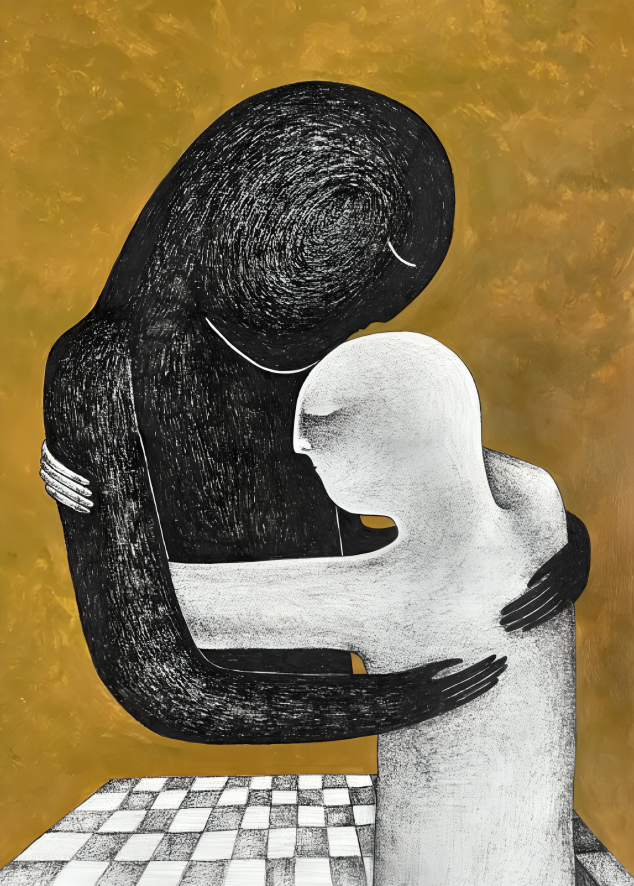
Artwork by Mélissa ChalhoubI had a dream last week where I completely lost my temper.
In the dream, a familiar situation unfolded. The kind I’ve learned to navigate calmly in waking life. But there I was, reacting exactly how I used to: defensive, saying things I’d never say anymore. When I woke up, I felt disoriented. Why was I still that person in my dreams when I’m not that person anymore?
That’s when I realised: I’d changed my mind, but my body was still catching up.
The Gap Between Knowing and Being
Since going full-time as a coach, I’ve immersed myself in neuroscience, somatic practices, and behavioural change. I’ve tested everything on myself first, new frameworks, different ways of thinking, tools for emotional regulation. And honestly? They worked. I became more composed, more aware of my triggers, better at choosing my responses instead of being hijacked by them.
I had it all figured out. Clear goals. Healthy inner dialogue. A working model of who I wanted to be, or so I thought.
But then came the dreams. And the reflexive flinches. And the moments when my body would react before my mind could even catch up: a familiar voice triggering old defensiveness, a situation pulling me back into a pattern I thought I’d left behind.
It was as though my body hadn’t gotten the memo yet.
What the Body Remembers
There’s a phenomenon I didn’t expect to encounter: somatic memory.
Your body stores reactions, patterns, and conditioning in ways that live beneath conscious thought. These are beyond mere mental habits, they’re encoded in your nervous system, your muscle memory, your reflexes. You can intellectually understand why you shouldn’t react a certain way, you can even consciously stop yourself from reacting that way in the moment, but the body still wants to do what it’s always done.
This is why the dreams shook me. In waking life, I was making different choices. But in my subconscious, where the mind’s editorial control loosens, the old patterns emerged fully formed. My body was still rehearsing the old script.
I started noticing this everywhere. A certain tone of voice and my shoulders would tense before I even registered why. A familiar dynamic and I’d feel my jaw clench, my breath shorten, all before any thought arrived. The action came before the awareness.
And here’s what surprised me most: this is completely normal!
The Practice of Waiting
I think we underestimate how much time transformation actually takes.
We focus so much on mindset, on having the right frameworks, the right awareness, the right intentions. And those things matter. But they’re only half the equation. The other half is giving your nervous system time to rewire, giving your body permission to unlearn what it spent years learning.
You can’t rush this part. You can’t think your way through it.
All you can do is keep showing up. Keep making the new choice, even when the old impulse arises. Keep noticing when your body pulls you backward, and gently redirecting it forward. The repetition is what teaches the body. Not the theory. Not the understanding. The lived experience, over and over, until the new pattern becomes as automatic as the old one was.
My lesson: Be Kind to the Lag
The hardest part is catching yourself in it and not spiralling into judgment.
There’s a voice that wants to say: You should know better by now. You’ve done the work. Why are you still reacting this way?
But that voice doesn’t understand how bodies work. How neural pathways work. How change actually happens beneath the surface of intention.
When I notice myself reverting in a dream, in a reflexive reaction, in a moment when the old self shows up uninvited- I’m learning to meet it with curiosity instead of criticism. Oh, there you are. I see you. You’re still here. That’s okay.
The body isn’t being stubborn, but being careful. It learned these patterns for a reason, probably to protect you at some point. It’s not going to let them go until it trusts that the new way is safe, sustainable, real.
The Unfinished Part of Growth
I’m sharing this because I think we don’t talk enough about this phase much, the messy middle where you’ve done the inner work but you’re still catching echoes of who you used to be.
It’s easy to feel like you’re failing when you notice the lag. Like the transformation wasn’t real, or didn’t take, or wasn’t enough.
The lag is the body’s timeline. And if you’re aware of it, if you’re noticing the gap between how you think and how you reflexively react, that awareness itself is progress.
The body will eventually get there. It just moves on a different clock than the mind. All you have to do is keep choosing the new way, and trust that repetition is quietly rewriting the old code.
One day, you’ll dream differently too.